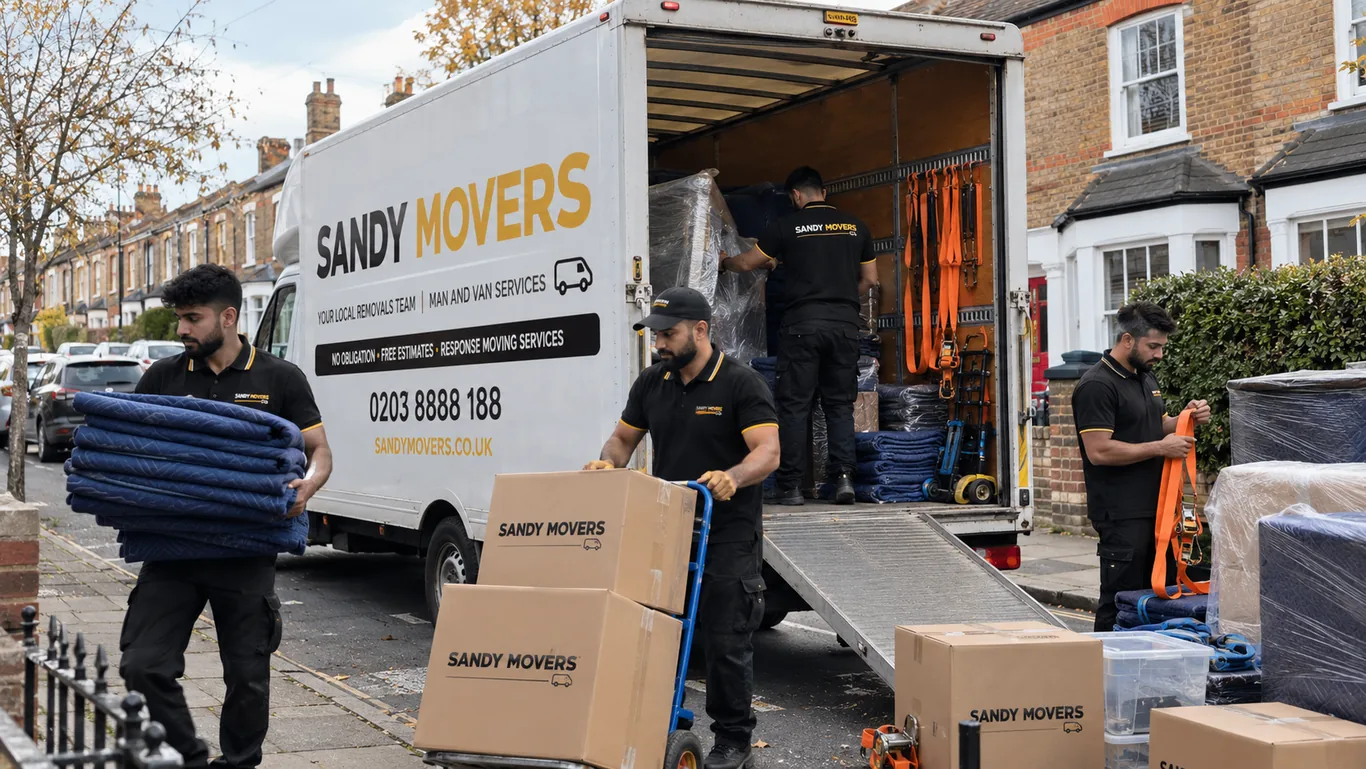
Site-to-site equipment transfer planning guide
For site closures, contractor handovers and returns to yard, focus on the equipment register, ownership, receiving teams and safe route—not only the addresses.
Planning an equipment transfer between projects
A site-to-site transfer is a controlled handover. Agree what leaves the first site, where each group of items goes, who can release it and who is able to receive it. Some contractor equipment is hired, some belongs to a subcontractor and some may be needed until the final handover: a generic request to 'move the remaining kit' can create avoidable delays.
Sandy Movers moves suitable equipment in its van fleet between project sites, depots and yards. A request can cover a closure, a new project opening, a return to storage or multiple collection points. We confirm the load and the appropriate crew before accepting the work.
Start with an equipment register, not only a postcode
| Transfer field | What the site team should provide |
|---|
| Description and count | Panel, barrier, tool case or furniture type, quantity and identifying references |
|---|
| Ownership | Company-owned, hired or subcontractor equipment; return instructions where relevant |
|---|
| Collection | Correct site entrance, equipment location and authorised release contact |
|---|
| Destination | Receiving site, hire depot, yard or storage unit, with person responsible |
|---|
| Readiness | Packed, dismantled, disconnected or still in use |
|---|
| Transport details | Actual dimensions, gross weight, stacking and handling requirements |
|---|
| Condition / contents | Known damage, missing accessories, liquids, batteries or contamination |
|---|
Use the free-text equipment field and the stop-specific notes in the existing enquiry form. You do not need an elaborate inventory system to start, but a clear list avoids mixing owned equipment with hire returns.
Site closure and handover deadlines
A project may have a fixed strip-out date, a restricted goods-out window or a client handover that cannot be moved. Tell us which deadline matters: leaving the site, delivering to the next project, returning hired goods, or clearing a designated bay. We can plan a collection time and arrival window subject to route and vehicle availability.
Handover delays often begin before the van arrives: equipment is still being used, access is incomplete, a keyholder is unavailable or a subcontractor has not signed off release. Tell us what is genuinely ready. Where the scope changes, we will discuss the revised route, time or trips before proceeding.
Owned kit, hired equipment and waste are different things
Hired equipment should have a confirmed return location, any hire-company reference and an agreed receiving process. Delivery to the depot does not itself prove a hire contract ended. Reusable equipment is not automatically waste; discarded material, contaminated goods and disposal must be assessed separately under relevant duties. See the GOV.UK waste duty of care guidance.
Transfer routes, stops and repeat journeys
We can plan site-to-site, yard-to-site, site-to-yard and mixed routes. Add the full route in order; the form starts with collection and delivery and lets you add intermediate stops only when needed, move them up or down, and mark each as collection, delivery or both.
A two-stage job may be safer or more practical than forcing everything into one load. For example, move equipment from an initial site to the receiving project, then collect a separate group from another depot and return to the receiving project. That is an illustrative workflow, not a promise of a particular number of trips or savings.
The largest simultaneous load, not just the number of stops, determines vehicle suitability. Equipment left in the van after a drop or added at a later collection changes axle weights and restraints. DVSA explains changing loads and securement.
Vehicle fit: capacity, odd shapes and weights
For the appropriate Sandy Movers vehicle, the stated working payload limit is up to approximately 1,000 kg, subject to its actual plated and operating weights and axle limits. A load that is under the nominal limit can still be unsuitable because of concentrated weight, handling or dimensions.
The usable load length can be around 4 metres and width about 1.8 metres depending on which van is assigned. Do not confuse a roughly 3-metre overall vehicle height with available internal cargo height: an item standing 3 metres tall cannot be assumed to fit in a closed van. Photographs and measurements help us assess an unusually shaped load, including whether a safe alternative orientation exists.
Count fencing accessories as carefully as the panels
The combined weight of temporary fencing bases, feet, barriers, tool boxes and furniture can be more restrictive than floor area. Tell us how many bases and clips travel with panels, whether barriers have ballast, whether cabinets still contain tools, and whether the load can be secured without damaging fragile items.
Contacts, sign-off and loading responsibilities
Every site needs a release or receiving contact. State who is authorised to hand over the equipment, what should be signed for and how missing items should be recorded. A simple quantity or condition handover can be agreed; don't assume a live tracking or proof-of-delivery system is included without discussing it.
State whether site staff handle the loading and unloading or whether you want the driver to assist, a two-person crew, a three-person crew, or our recommendation. Conditions may differ at each stop: a contractor team at the pickup may have lifting equipment, but the receiving site may have only stairs and a distant goods-in point.
Site-specific induction, PPE, gates, delivery permits and available mechanical handling must be established in advance. A van's tail lift, when provided, is subject to its rated capacity and safe operating conditions, not an alternative to specialist plant-handling services.
How we handled a changing real contractor brief
On 4 November 2026 Sandy Movers completed an anonymised contractor job with equipment movements involving Godalming, Oval and Hertford, returning to Oval in a separate stage. The initial equipment description included temporary fencing, barriers, cones and site furniture. Further equipment was added to the later collection, which required the scope and labour planning to be reviewed.
This experience is useful because the challenge was not a single point-to-point parcel delivery; the work involved multiple sites, two transport stages and a changed equipment brief. The full anonymised case study describes the inventory and lessons without identifying the customer or publishing financial details.
Where your job is more about several supplier pickups than project handover, see multi-stop business transport. For item dimensions and construction materials, see construction equipment transport.
Request a transfer quote with fewer delays
Send the route, location contacts, equipment count, weight where known, agreed loading support and handover deadline. Include hire-return references and site restrictions. Confirm if the transfer will require two vehicle loads or if the quantity is still changing.
Use the commercial transfer enquiry form near the top. We review timing and availability before providing a personalised price; the enquiry is not a booking. You can also read our insurance terms and customer reviews before deciding.